
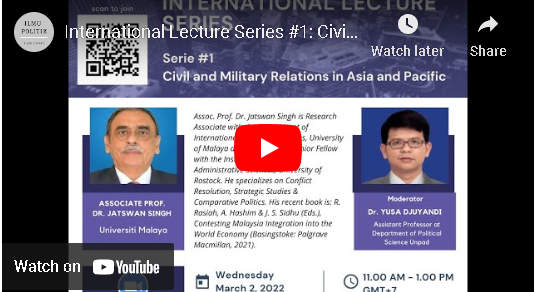
Civil and military relations have become an important area of study in Political Science. Not only that, from the experience of various countries in managing civil and military relations, we can also learn that the regulation of relations between the two is dynamic, especially when defining what kind of civil control over the military should be implemented or how military professionalism in a democratic context is realized.
This discussion on civil and military relations was delivered by Assoc. Prof. Dr. Jastwan Singh in a public lecture which is part of Political Science’s International Lecture Series . Prof. Jastwan Singh is a Research Associate at the Department of International & Strategic Studies, University of Malaya and non-resident Senior Fellow at the Institute for Politics & Administrative Sciences, University of Rostock. He is an expert in Conflict Resolution, Strategic Studies & Comparative Politics studies.
In the lecture attended by Unpad Political Science Study Program students and general participants, Prof. Jastwan also gave an example of the management of civil and military relations in the Asia-Pacific, by raising specific cases in three countries, namely Pakistan, Myanmar and Thailand. In conclusion, there are 2 important things that are prerequisites for civil and military relations to become democratic. These two things are that democracy will not be institutionalized without the support of military elites who are committed to democratic rules and obey democratically elected political leaders. Apart from that, civilian control over the military is needed so that the use of strategic and vital resources for the country can be more accountable.